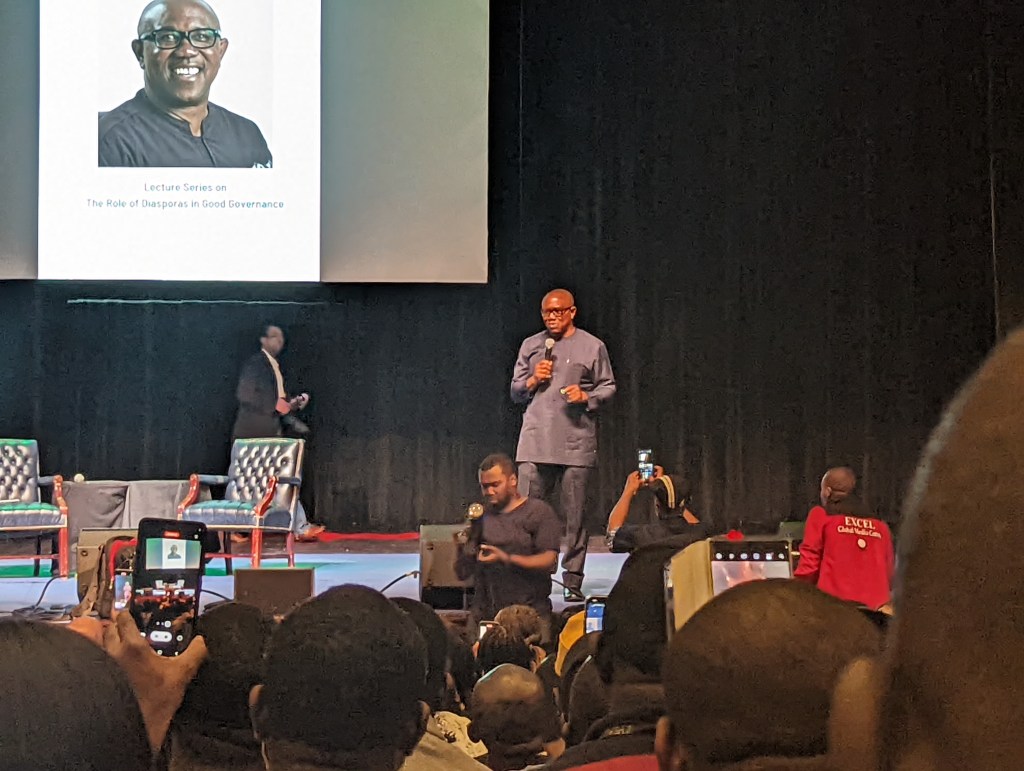
On Thursday, Nigerian presidential candidate Peter Obi stopped by Howard University’s Cramton Auditorium to deliver a lecture on good governance, as the West African nation’s presidential campaign season kicks off.
Although the event started an hour late, the 1,500-seat auditorium was packed when Obi entered the venue, and his supporters, who call themselves ‘Obidients,’ greeted his arrival with a standing ovation and rousing applause.
The lecture, which was the seventh stop on a nine-city world tour, was focused on the importance of the Nigerian diaspora in bringing about a new era of corruption-free rule in Nigeria.
Campaigning for the February 2023 presidential election cannot officially begin until September 28th, but Obi referred to his tour as a “listening session.” He was looking to hear from members of the Nigerian diaspora. “The first investors are you,” Obi exclaimed. He plans to rebuild Nigeria’s economy into a worldwide powerhouse.
At its core, Obi says his campaign is about restoring faith in Nigeria’s institutions, and bringing prosperity and good governance to the largest nation in Africa. He spent much of the lecture calling out current and former leaders of Nigeria for their inability to provide widespread economic opportunity for the country’s people and for increased rates of crime and joblessness amongst the country’s youth.
“It is a structure of criminology…That is a corruption structure. It is that structure that kept us where we are, and that is what we want to dismantle,” Obi said, to the loudest applause of the night.
He made frequent comparisons to other countries that have rapidly developed, like Bangladesh, Vietnam, and China, rattling off statistics about GDP, production capacity and per capita income to make the point that Nigeria was falling behind some of its counterparts.
“By 1981, Nigeria’s per capita [income] was $2,000, over $2,000. We were six, seven times the per capita [income] of China, better than Vietnam, South Korea, Bangladesh…These were very poor countries that were never compared to Nigeria,” Obi said. Today, Nigeria’s per capita income is $2,085, slightly below what it was in 1981. China’s is $12,556, up from $197 in 1981.
Mr. Obi will appear on the ballot alongside over a dozen other candidates in the crowded race to replace outgoing President Muhammadu Buhari, but he’s positioning himself as a third-party alternative to political heavyweights Bola Ahmed Tinubu, a former governor of Lagos state for eight years, and Atiku Abubakar, Nigeria’s former vice president of the early 2000s and member of the People’s Democratic Party.
To some, Obi’s candidacy stands out as uniquely untouched by the pervasive influence of corruption.
Temple Anyasi, a recent Cornell graduate and son of an Igbo immigrant, is a supporter of Obi and intends to return to Nigeria in February to cast a ballot in support of him.
“It’s kind of hard to support the other side…Peter has the youth support and he’s trying to turn the country around. Tinubu is a corrupt, drug dealing millionaire,” he said. “Because so many of Nigeria’s issues – police, electricity and exports – are national, whoever wins the presidency controls it all,” Mr. Anyasi said.
Obi’s speech touched on more than financial figures and economic development plans.
Religious and ethnic backgrounds have historically played a major role in Nigeria’s political structure. Obi, being both Christian and an Igbo from the Southern part of the country, would present a clear contrast from the two other major candidates and would become only the second Igbo president in the nation’s history if elected.
In a nod to these conflicts, Obi made a point to conduct both a Christian and Islamic opening prayer to start the lecture and downplayed such divisions, calling them a “conspiracy to keep the country where it is today” and pointing out that “Nigerians have shown the capacity to come together when there is anything that gives them hope.”
As for the possibility of becoming only the second Igbo president in Nigeria’s history? Obi didn’t put much stock into it, asking voters to only consider his ability to turn the country around.
“Do not vote for me because I am from the Southeast. Do not vote for me because I am a Christian…Don’t vote for me because of my party…2023 election should be about character we can trust, it must be about competence, it must be about the capacity to steer Nigeria in the right direction.”
Obi’s tour is scheduled to make two more stops in North America, including Atlanta and New York City, before heading back to Nigeria for the start of the presidential campaign season. The presidential election will be held on Saturday, February 25, 2023.
This story was written to fulfill a writing requirement for Multimedia Storytelling.
 Julius Washington Reports
Leave a comment